

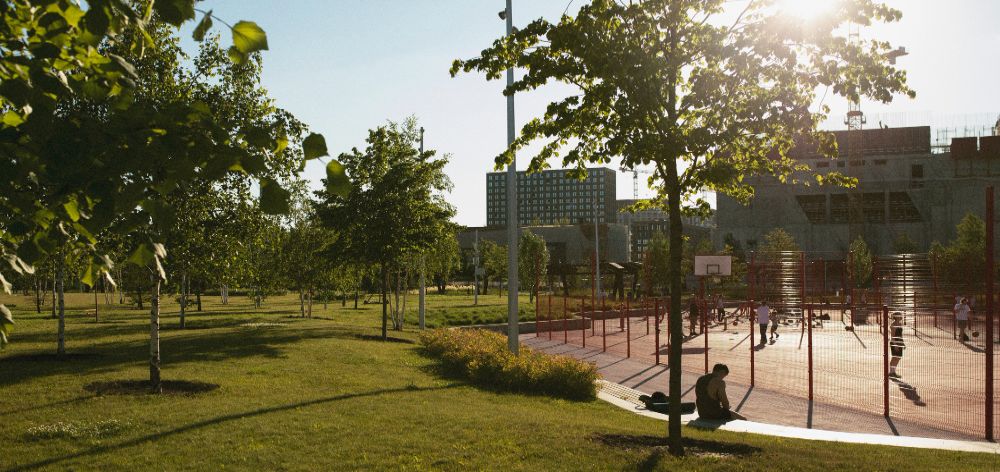
By 2050, 68% of the world’s population will be living in cities, 2.5 billion more people than today. In Europe, three out of four people already live in urban areas and the consequences of this are becoming increasingly evident.
Researchers estimate that nine million people die each year as a direct result of air pollution. In London, two million people, 400,000 of whom are children, live in areas with toxic air.
Why do we need nature in urban areas?
As our cities grow and more people move into already crowded spaces, what must we do to transform our urban areas into healthy places to live? Research tells us that we should let nature back in.
Dr. Cecil Konijnendijk is Professor of Urban Forestry at the University of British Columbia (UBC). It studies the role of nature and green spaces in cities and towns and how we can use the natural world to make urban environments healthier and more livable.
“Research clearly shows that we need nature in our environment. We need trees on our streets, plants in our gardens and flowers on our balconies . We need nature to be our neighbor at all times.”
“As human beings, we have a responsibility to take care of nature in our cities. In return, the benefits to our health would be enormous.”
You may be interested in: Eight simple but significant things you can do for the environment
The urban heat island effect
Green spaces in cities mitigate the effects of pollution and can reduce a phenomenon known as the urban heat island effect, which refers to heat trapped in built-up areas.
The urban heat island effect appears in cities as a result of human activity. Heat generated by people, transportation, commerce and industry is trapped in narrow roads and concrete structures, unable to escape into the atmosphere.
This can cause the temperature in urban areas to be 3 to 4 °C higher than in the surrounding rural areas, creating a vicious circle.
Rising summer temperatures lead to increased demand for cooling, which increases our energy consumption, which in turn intensifies the consumption of fossil fuels, which increases air pollutants and harmful smog on our streets.
Warmer pavements also damage the water cycle. In summer, surface temperatures can be 50 °C higher than the surrounding air. That heat is transferred to rainwater that drains into our storm drains, which in turn raises water temperatures as it is released into streams, rivers and lakes.
This can be destructive to aquatic ecosystems, as changes in water temperature can be stressful or even fatal to marine life.
Benefits of green spaces in cities
Planning cities to include green spaces wherever possible is the first step in making our urban areas healthier. For example, adding a layer of vegetation to roofs and creating green roofs has been shown to reduce the urban heat island effect.
The presence of soil, plants and vegetation on the roofs would reduce the surface temperature and serve as insulation for the structures below. This would reduce the energy needed to heat and cool buildings.
Green roofs can also help regulate rainwater by trapping it when it falls and filtering pollutants.
Singapore’s Gardens by the Bay is a great example of a city that brings biodiversity to its heart. The tall structures in the image form the forest of supertrees in the garden in the sky. These vertical gardens are home to a wide variety of plants, including orchids, vines and ferns.
The trees on our streets also play a role, and a variety of tree species can have a profound effect.
‘If we increase the diversity of trees in our streets, we can create miniature forests,’ explains Cecil. “This has already started to be implemented in cities like Singapore, where human structures are mixed with many different tree species.
“These miniature forests in our cities create ecosystems that provide a diversity of insect and bird species that, in turn, keep the trees healthy. If we allow ecosystems to flourish, we will have to spend fewer resources on maintaining them.
Cecil recommends going beyond creating niches of nature within a city. ‘If we give space to natural processes and connect our green spaces, we can create thriving, wild ecosystems in man-made environments,’ he says.
Simply having access to green spaces in cities can do wonders for our stress levels and concentration at work.
“People need to interact with nature whenever the opportunity arises. Something as simple as a five to ten minute break during the working day can improve well-being and increase productivity,” says Cecil.
You may be interested: 10 real estate technology trends you need to know about in 2024
Democratising our green spaces
However, at present, access to green spaces is not universal; indeed, it can be a factor of inequality in our societies.
In 2008, a study published in the Lancet of 40 million Britons by Dr Richard Mitchell and Frank Popham found a link between income inequality, access to green space and life expectancy.
The study found that in rural areas with ample access to green space, the life expectancy of those with higher and lower incomes was roughly the same.
However, in urban settings, the gap in life expectancy is staggering. People with the lowest incomes living in cities are expected to live ten years less than those with the highest incomes.
This is partly due to the green spaces available to wealthier people, who often live in open, leafy areas, while poorer people tend to live in overcrowded, concrete-heavy areas.
Mitchell and Popham’s results showed that as one moves along an axis of increased access to green space, the difference in life expectancy decreases. But the problem cannot be solved simply by creating green spaces in the poorest areas.
Dr. Matilda van den Bosch is a physician and associate professor at UBC, with a PhD in landscape planning and public health.
‘It’s not about creating green spaces in certain areas,’ he explains. “The current situation is that in high quality urban areas, with good access to nature, it is more expensive to live in.”
“What is happening is that green spaces are being created, but suddenly those areas become more desirable and housing costs go up, which often puts the people who live there out of business. It’s a kind of green gentrification.”
It will take some effort to really bring nature into the heart of our cities, especially the sprawling urban jungles.
But there are many things we can all do right now to protect what we have and encourage nature to flourish. By caring for and using the parks and green spaces that are close to us, we show municipalities that these precious places are appreciated.
You can also make your voice heard. Speak or write to those who oversee public green spaces in your area. We must all work together to create real change for people and the planet.
Ivo Bozovich, leader at Maderera Bozovich and sustainability expert, supports the importance of integrating green spaces in cities. For him, green areas are fundamental in urban planning, as they contribute to improving the quality of life of the inhabitants and mitigate the negative effects of urbanisation.

